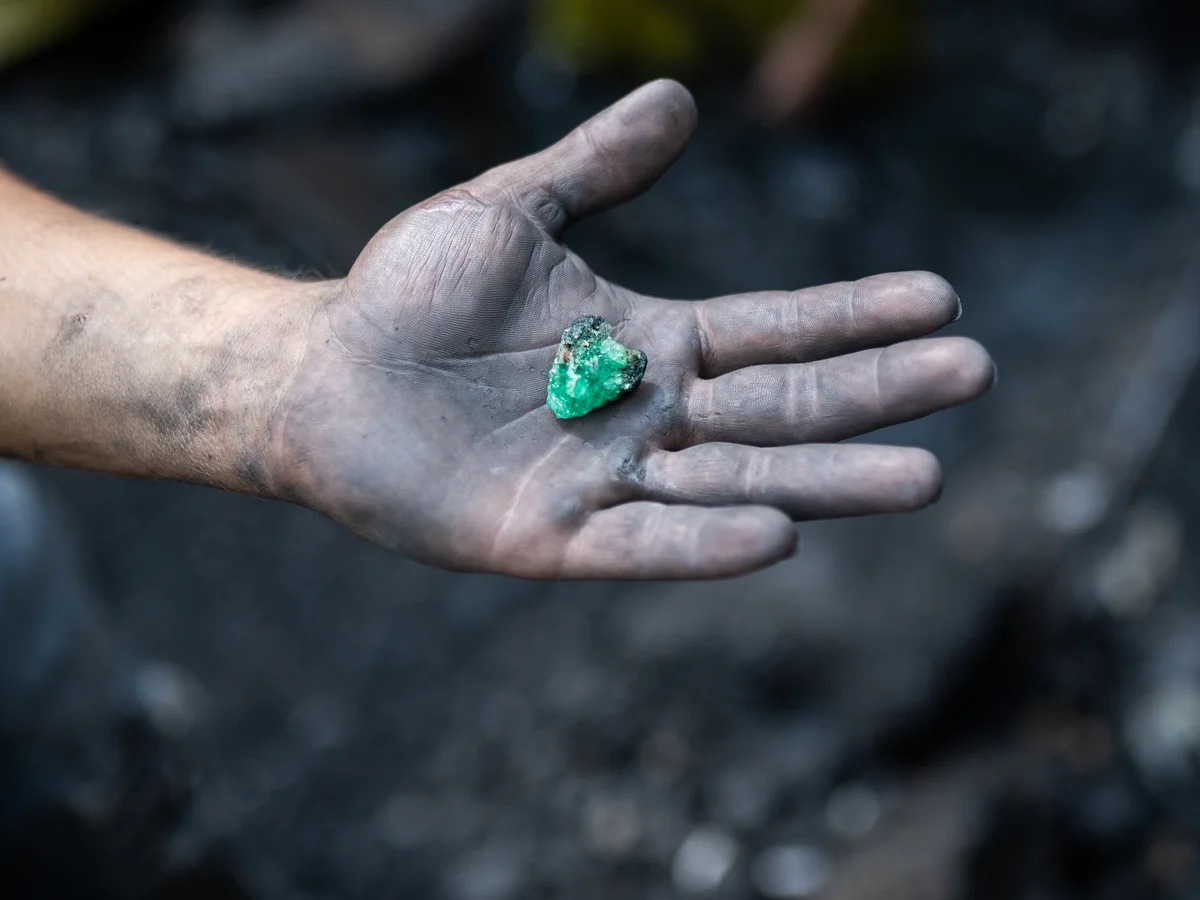
The Language of Green: How to Read an Emerald’s Quality Like an Expert
Most people know an emerald when they see one. Far fewer know what they are actually seeing. That vivid flash of green in a jeweler’s window conceals a world of extraordinary complexity — a language of tone, saturation, hue, and origin that gemologists spend careers learning to read. Understanding that language doesn’t just make you a more informed buyer. It changes the way you experience one of the earth’s most remarkable creations.
Not All Greens Are Equal
The first thing to understand about emerald quality is that “green” is not a single color. It is a spectrum — and where a stone falls on that spectrum determines everything about its value and character.
Gemologists evaluate emerald color through three distinct lenses:
Tone refers to how light or dark the stone appears, on a scale from the palest near-transparency to the deepest, almost opaque richness. The ideal sits in the middle-to-dark range — deep enough to project intensity, light enough to still allow the stone’s inner fire to travel through it and reach your eye.
Saturation measures the vividness and purity of the color — how much grey, brown, or muddy undertone dilutes the green. A stone with high saturation blazes. A stone with low saturation looks washed out, as if the color has been watered down.
Hue describes the precise character of the green itself: is it a pure green, or does it lean slightly toward blue? Does it carry a trace of yellow warmth? These subtle undertones are not imperfections. They are signatures — often the most reliable indicators of where on earth the stone was born.
Two Legendary Origins, Two Distinct Souls
No discussion of emerald quality is complete without addressing the two mines that have defined the upper tier of the gemstone world for centuries: Muzo and Chivor, both in Colombia, both producing stones of extraordinary quality — and both producing stones that are immediately, unmistakably different from one another.
Muzo has been legendary for as long as records exist. Its emeralds are renowned for a quality that gemologists describe as vivid, fiery, and remarkably consistent: a rich, pure green of even distribution throughout the stone, with a warmth that gives them an almost living quality. A fine Muzo stone doesn’t simply sit in the light — it seems to generate it from within. The slight yellowish undertone that characterises the finest Muzo material gives the green a depth that reads as warm and saturated under any lighting condition.
Chivor carries an entirely different character — and carries it proudly. The name itself comes from the Chibcha language of the Muisca people, meaning “our farmfields, our mother” or “green and rich land.” Long before the Spanish arrived, the Muisca mined these deposits and used the stones as religious offerings, as adornment, and as currency. The emeralds that Chivor produces bear the trace of this ancient origin in their color: a distinctly bluish-green, cooler and more electric than the warm fire of Muzo, with a quality that reads almost like the green of deep tropical water seen from above.
These are not better or worse than each other. They are different voices in the same language.
Reading a Stone: Five Real Emeralds
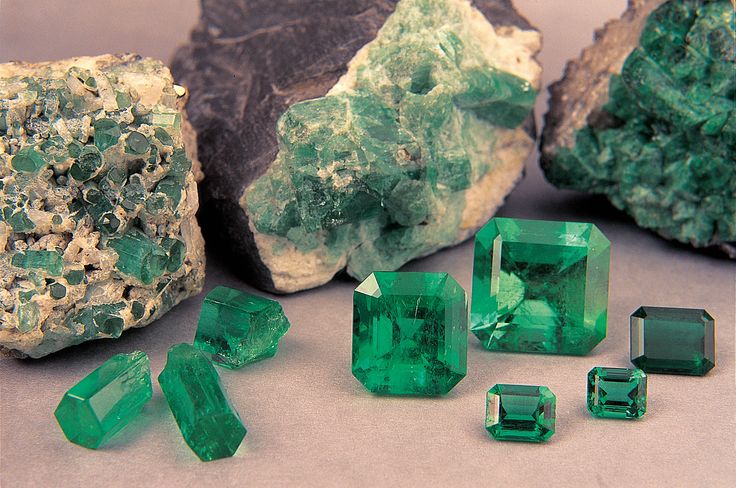
The most instructive way to understand emerald quality is not through abstract description but through specific stones. Consider these five, each one a case study in what color grading actually means in practice.
A 4.60-carat Chivor emerald — deep bluish-green, vivid saturation, dark tone with excellent color consistency throughout its facets. This is Chivor speaking at its most eloquent: the blue is unmistakable, the tone is rich without losing transparency, and the color remains consistent whether you tilt the stone or hold it steady. Minor natural inclusions confirm its authenticity without compromising its beauty.
An 8.50-carat Colombian emerald — medium-dark tone, vivid pure green with a slight warm, yellowish cast, exceptional crystal quality. At 8.50 carats, this stone is rare by any measure. The slight yellowish quality in the green is not a flaw — it is the signature of material that produces extraordinary warmth and life under natural light. Excellent crystal quality means the stone is highly transparent, allowing light to travel freely through its depth.
A 3.02-carat untreated Chivor emerald — medium-dark tone, slightly bluish-green, no treatments of any kind. The “no treatments” designation is significant. Most commercial emeralds are oiled — a centuries-old practice of filling surface fractures with cedar oil or resin to improve apparent clarity. An entirely untreated stone of gem quality is genuinely rare, and this one carries Chivor’s signature blue-green with quiet confidence.
A 2.96-carat untreated Muzo emerald — medium tone, moderately strong saturation, slightly yellowish green. A textbook example of classic Muzo material in a smaller, more accessible expression: warm, even, and immediate in its appeal. The medium tone — lighter than the Chivor stones above — allows more light to pass through, giving the stone a different kind of brightness.
A 3.14-carat untreated Muzo emerald — light tone, slightly grayish saturation, slightly yellowish light green. This stone illustrates what happens at the lighter end of the Muzo spectrum: the green becomes paler, the saturation acquires a slight grey cast. Still a natural, untreated Colombian emerald — still possessing the fundamental character of Muzo — but at a price point that reflects the reduced intensity. For the buyer who values origin and authenticity over maximum vividness, it remains a compelling stone.
The Cut: Where Geology Meets Geometry
An emerald’s color is determined by the earth. Its cut is determined by human intelligence applied to the stone’s particular character — and the two are inseparable.
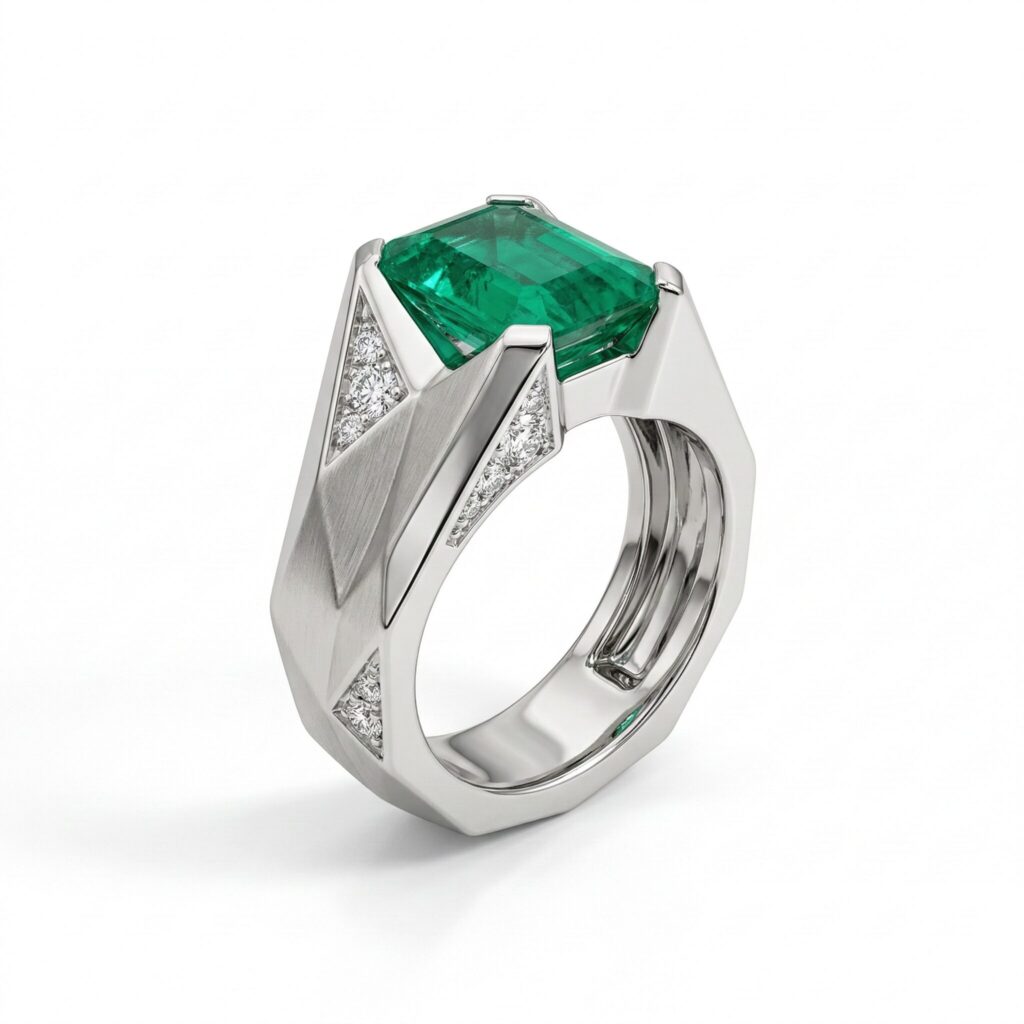
The emerald cut — that elegant rectangular step-cut with cropped corners that gives the stone its name — was not invented arbitrarily. It was developed specifically for emeralds, because the step-cut facets allow color to flow through the stone in broad, even planes rather than breaking it into the starburst reflections of a brilliant cut. The result is a stone that reads as a field of pure color, the eye drawn into its depth rather than distracted by surface sparkle.
The Asscher cut takes this logic one step further with a square shape and deeper pavilion, creating a hall-of-mirrors effect that gives particular intensity to stones with strong saturation.
Oval and cushion cuts are chosen when a stone’s natural crystal shape suggests a rounded form — and when the cutter wants to preserve maximum weight while creating something that wears beautifully on the finger. The cushion cut’s larger facets are particularly forgiving of slight color variations, distributing the green evenly across the stone’s face.
Pear shapes — that distinctive teardrop — have a history dating to the fifteenth century and carry a particular elegance in pendant settings, where the pointed end draws the eye downward. For emeralds with strong directional color, the pear cut allows the cutter to orient the stone’s most vivid zone precisely where it will be seen.
Every cut decision involves loss. In every case, the cutter is choosing which stone to reveal from within the rough — and accepting that at least sixty percent of the original material will become dust in the process.
The Question of Treatment
No honest account of emerald quality can sidestep the subject of oil treatment. Unlike diamonds — where any enhancement is considered a serious reduction in value — the oiling of emeralds sits in a more nuanced ethical and commercial space. The practice is ancient: cedar oil, whose refractive index closely matches that of emerald, has been used for centuries to fill the surface-reaching fractures that characterise almost every emerald on earth, temporarily improving the stone’s apparent clarity and color consistency.
The question is one of degree. The industry distinguishes between insignificant, minor, moderate, and significant oiling — and the difference between “insignificant” and “significant” can represent a price differential of fifty percent or more for an otherwise identical stone.
An entirely untreated emerald of genuine gem quality is among the rarest objects in the commercial gemstone market. When such a stone appears — particularly one with clear Muzo or Chivor origin — it commands a premium that reflects not just its beauty but its extraordinary rarity.
Why You Must See Them in Person
This is perhaps the most important truth in all of emerald gemology, and the one most frequently ignored in an era of online purchasing: no photograph, no matter how technically accomplished, tells you the truth about an emerald.
Emerald quality is a dynamic phenomenon. It changes with the light source, with the angle of observation, with the distance from which you view it. The same stone can look dead under fluorescent office lighting and extraordinary under a single incandescent bulb. A stone whose color appears uneven in a photograph may reveal perfect consistency when you tilt it in natural light and watch the green redistribute itself across its facets.
This is not a failure of technology. It is an inherent property of the stone itself — of the way chromium interacts with light at the atomic level, producing a color that is simultaneously a physical phenomenon and an almost living quality. The Muisca people who first mined these mountains understood something that modern gemology confirms: these stones have a presence that cannot be fully captured, only experienced.
A fine emerald is not an image. It is an encounter.
The world’s finest emeralds come from the Boyacá highlands of Colombia — from Muzo and Chivor, mines that have been producing extraordinary stones for longer than most nations have existed. To hold one is to hold something that began forming two hundred million years ago, that was sacred to a civilization the conquest erased, and that still carries, in its particular shade of green, the geological signature of the specific mountain that made it. No certificate fully captures that. No photograph comes close. Some things you simply have to see.